Why Owning a Freehold Condo May Not Be A Trump Card

In recent months, I have been bringing clients to view freehold and leasehold resale properties in Districts 10 and 11. Hence, we started looking at data of how some freehold condominiums performed against leasehold ones, and the analysis gave us a different perspective from the instinctive idea that owning a freehold condominium is always better than a leasehold unit.
First of all, one caveat on considering freehold versus leasehold properties is that the landed sphere is excluded. This is because a freehold unit in the landed market is usually superior to a leasehold property, all things considered, given the scarcity of land for landed units. This scarcity comes about because there are no more government land sales (GLS) for developers to bid for land to build landed properties anymore. Hence, the prices of landed properties have been skyrocketing, especially with Good Class Bungalows, given their rarity amidst a landscape of a growing number of ultra-high networth individuals on our island.
However, this is not the case for condominiums, or private residential strata. There are still land plots released for GLS for developers to bid yearly, to build new condominiums, and all GLS plots are leasehold, none are freehold. The only way for developers to secure a freehold plot now is to do en bloc, and we all know how this process is fraught with multiple challenges. Given the increasing scarcity of new freehold condominiums, one would think that owning a freehold strata property may be a trump card against a backdrop of ever increasing leasehold condominiums. In reality, that is not the case, and I cite 2 case studies of freehold versus leasehold properties that are almost located side by side.
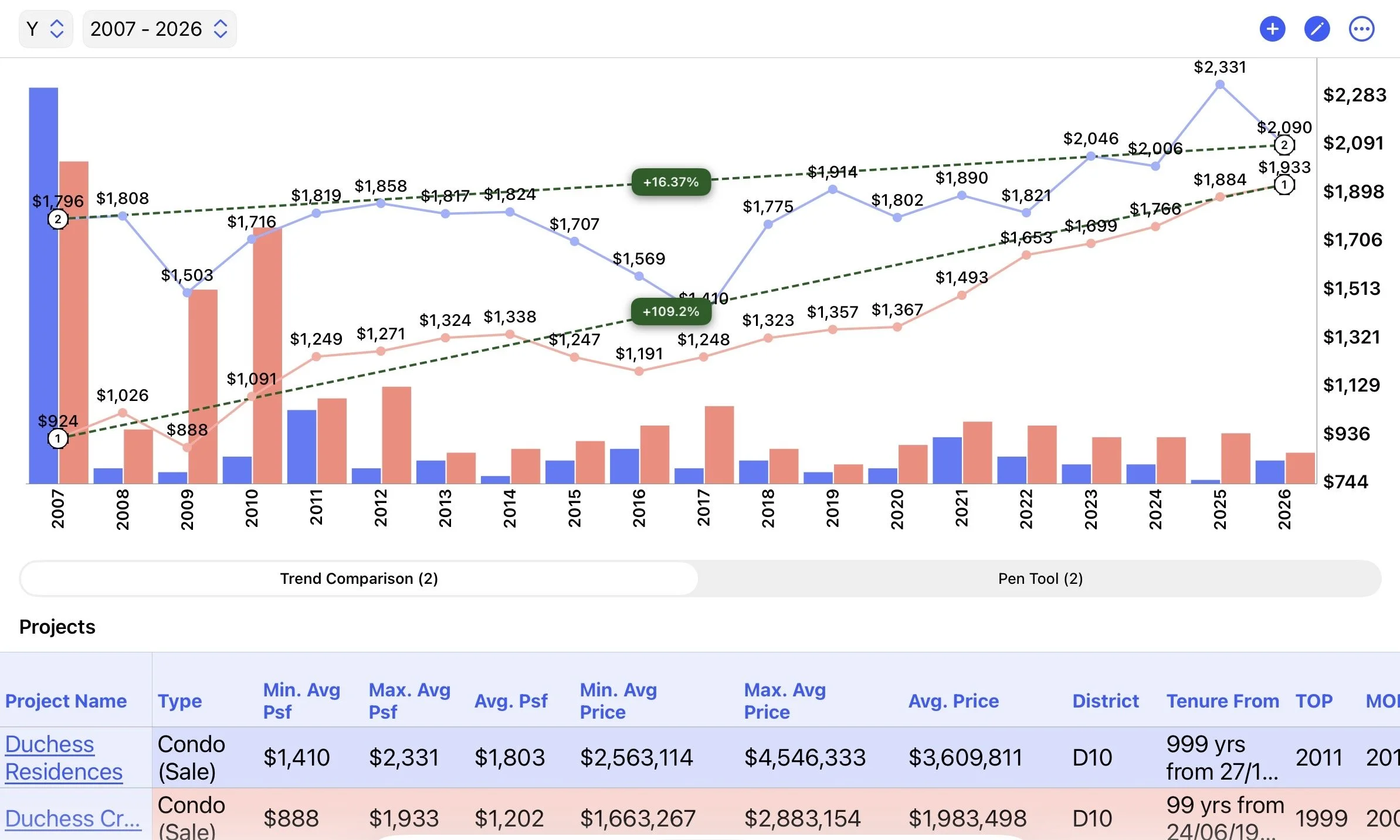
Profitability of Duchess Crest vs Duchess Residences
Comparing the developments of the 251-unit 99-years leasehold Duchess Crest and the 120-unit 999-years Duchess Residences at District 10, Duchess Crest more than doubled its value in appreciation over 20 years, compared to only a 16% profit for Duchess Residences in the same period. There are numerous reasons for this stark difference in performance, but I would just like to highlight that the leasehold development has more than double the number of units for the freehold, so it makes a difference when it comes to the volume of transactions that would help the leasehold appreciate faster in value compared to the freehold.
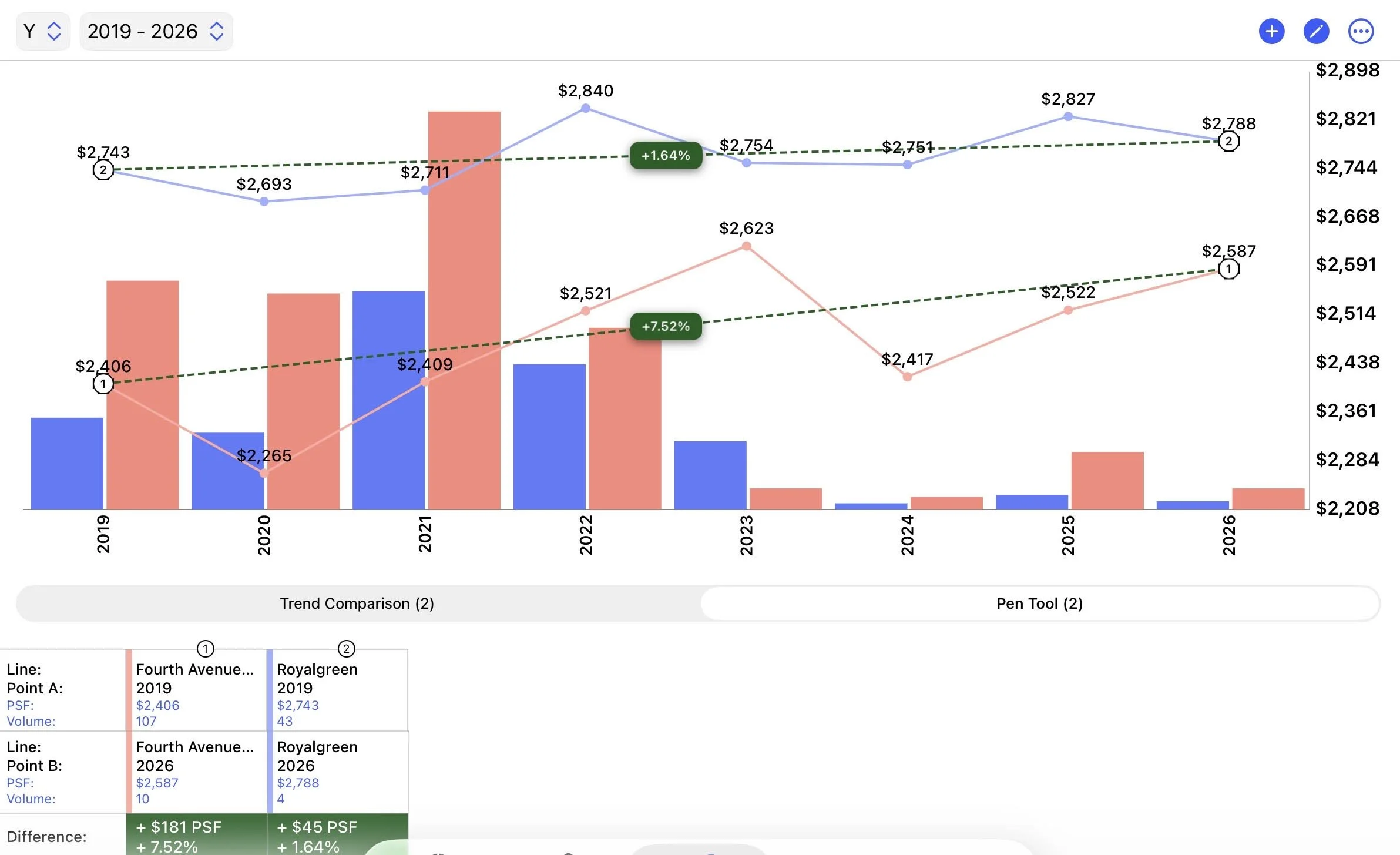
Fourth Avenue vs Royalgreen
The next case study is 99-years Fourth Avenue Residences versus freehold Royalgreen, sharing the same developer Allgreen, and launched in the same year 2019, walking distance to Sixth Avenue MRT. Fourth Avenue has also outperformed Royalgreen (7.52% appreciation versus 1.64% increase respectively). Hence, such data above only shows that owning a freehold condominium nowadays may not earn you as much capital gain, compared to a leasehold property, and thus a freehold unit is your hands is not always a trump card.
Of course, if you are one of the fortunate few who has owned a freehold property for decades, and your property has more than doubled or tripled in value, then I can understand why you would think freehold is always better than a leasehold. Some of the old rich in this generation have passed on such a belief to their next generation, and so many of their children ended up buying a freehold property, such as a 1-bedroom freehold in Bukit Timah (I shan’t name the development here). Actually the children would have gained more if they had opted for a resale HDB flat with a decent amount of lease years left instead, as the HDB would have increased in value more than a freehold 1-bedroom, even in a prime location.
Also, many people buy a freehold property, with the intention to hold on to that freehold property as an investment or a legacy asset to be passed on to the next generation. Thus, generally, I think the holding period for a freehold condominium unit tends to be longer than for a leasehold property. Hence, with more transactions in the leasehold sector, prices can appreciate faster there too.
There are many boutique freehold apartments in Geylang, so one factor why prices don’t trend up fast in many of these developments is that the units are too few to make up a substantial amount of transactions annually. Another reason is that many of these freehold developments are actually old, and their designs, dated, hence a lot of work (and cost!) has to go into refurbishing an old unit, overhauling the cabling, removing a bathtub etc. Not to mention that the maintenance and sinking fees go up over the years because lifts, for example, have to be upgraded, and to counter natural wear and tear. In fact, some design elements cannot be changed, such as no lifts in resort-like developments, so people have to walk up to an apartment. That is increasingly challenging for families with young parents with babies in prams, and carrying toddlers and hoisting up groceries, or even a fast greying population in Singapore, where creaky knees just can’t manage the stairs anymore. So, the buyer pool naturally shrinks and demand for such niche units drops.
So, we increasingly see the narrowing of the price gap between a freehold and leasehold property, cause lease is really not the only factor to consider when buying a property, whether new or resale. In fact, the healthy demand for new leasehold condominiums shows that people are increasingly savvy with their property purchases, and know they can still see appreciation even though the psf they pay may be higher compared to surrounding resale properties.
So here is my take. If you are really into freehold, then I think a brand new product with a mid-sized development like Meyer Blue (in between 2 TEL stations no less, Katong Park and Tanjong Katong), or freehold developments along Meyer Road, casually touted as the Nassim of the East, is a good consideration, given that there is, on this current horizon, no more supply of new units along this road that faces the sea (unless any of the 15 developments along this stretch goes en bloc successfully). Seaview units are high in demand here, and the development and population density here is less compared to areas in Tanjong Rhu and Amber. So units here would be a better buy if you are considering District 15. For resale freehold developments, say in the West Coast area, consider units at good-sized developments Botannia and The Parc. They are not so near the MRT, but both have done well and appreciated with good value over the years.
Otherwise, consider new leasehold developments that have sprung up or are going to, after the government has built public transport infrastructure such as the Thomson-East Coast line. Thomson Reserve makes for a really worthwhile development with many strong traits, if developers price it right, though with strong market interest, it would also not be priced cheap.
All in all, every individual has different property aspirations, needs and goals, and I believe a customised property plan is what is really needed when it comes to an individual’s asset progression journey. Then the deep dive into freehold versus leasehold continues.