The V-shaped Curve of Prices - a Window of Opportunity

You may have read that for the latest March 26 Dover Drive Government Land Sales (GLS) at the Greater one-North area, the top bid was submitted by a consortium of Chinese developers including Qingjian, for $951 million, or $1,556 psf per plot ratio (psf ppr). There were a total of 6 bids for the plot, and this top bid sets a new benchmark for GLS sites in the Rest of Central Region (RCR). What does this imply for those intending to buy into a private property in the near future?
One common complaint many people make about property prices in Singapore is that property prices keep increasing, and this observation is indeed true. The property market here in Singapore is a tightly controlled and highly regulated market, with stringent rules like Total Debt Servicing Ratio (TDSR) and cooling measures to ensure that people do not over-leverage when they take loans for their property purchases, and prices do not accelerate ahead of economic fundamentals. This has helped most property owners in Singapore in the capital appreciation of their properties, and facilitated their subsequent asset progression and upgrading.
Hence, the saying goes that time in the property market is better than timing the market, meaning that holding a (suitable) property over time, such that its value can appreciate with time, is more important than timing when you enter the market. But what if I share that I am advocating the opposite right now? That one should time the market and hop onto the property bandwagon while there is still a small V-shaped window of opportunity before future new launch prices significantly accelerate and reflect that market shift? (By the way, I should rightly attribute the concept of the V-shaped curve on property prices to our Propnex CEO, Kelvin Fong!)
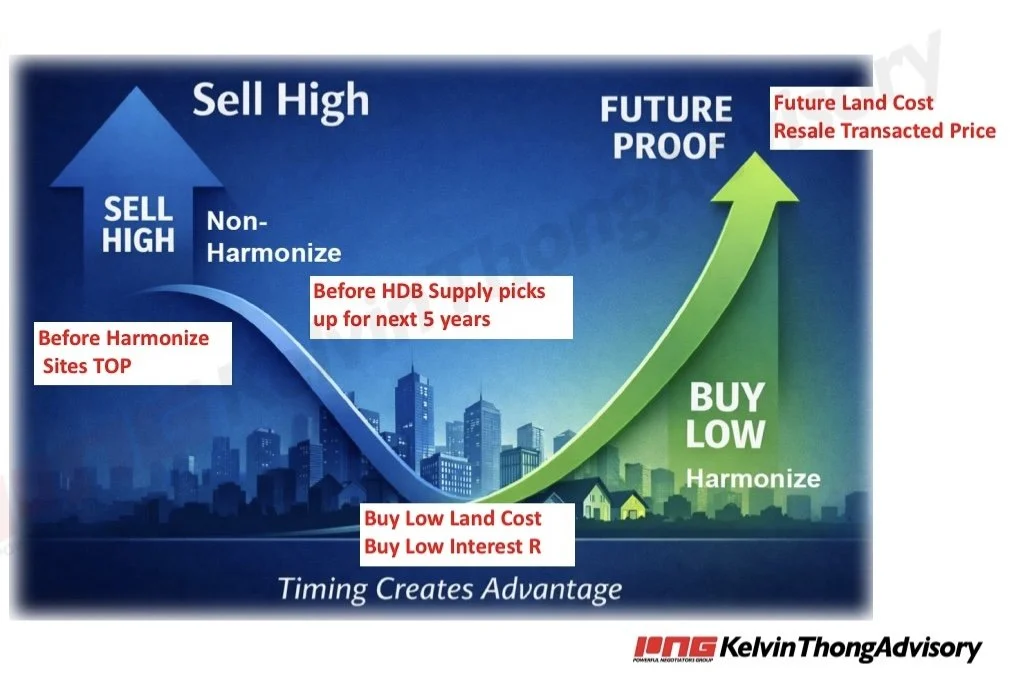
The V-shape Curve of Property Prices
Since the past couple of years, with new guidelines on unit layouts, developers for GLS sites now sell units that are GFA-harmonised, meaning that now all your strata space becomes 100% liveable space, as air con ledges, planter boxes and double-volume ceiling heights are all removed from the size equation. Currently, these GFA-harmonised sites are all under construction, meaning when these new developments TOP, they become a preferred choice because their layouts are more efficient than non-GFA harmonised condo developments. Hence, now is the right time to sell one’s non-GFA harmonised unit, and swap for a more efficient GFA-harmonised unit instead.
Also, the year of 2026 is when the number of HDB flats that reach their MOP (Minimum Occupation Period) doubles, compared to the year of 2025, and for the next few years at least, the number of MOP flats is only going to increase year on year, due in part to building delay over the Covid period. Hence, there is also an increasing supply of HDB resale units, and this is also happening in the context of HDB ramping up the number of BTOs and fast-tracking their building, with some BTOs ready for stay in less than 3 years from application. Hence, before the HDB supply picks up over the 5 years, it is also the right time to sell one’s HDB asset, and quickly make a move to buy into private properties.
The current environment is also one of low interest rates, but we also can’t predict they will continue to stay low, given the new situation with the US war on Iran, and Iran’s retaliatory moves, and the impact of their moves globally. That window of opportunity to sell high and buy low, before prices spike, is now, for these 6-9 months.
Why the Dover Drive bid of $1,556 psf ppr is significant is that it signals a new benchmark in GLS prices. RCR GLS sites are now sold at CCR prices of last year and even higher, OCR GLS sites are also now sold at RCR GLS prices of last year. To cite an example, Skye@Holland was immensely popular with 99% sold on Launch Day, because the developers could buy the land at $1,285 psf ppr in May 2024. But look at CCR prices now. A GLS plot beside Newton MRT was sold at a benchmark price of $1,820 psf ppr in November 2025; CCR GLS sites are never going back to ‘Skye-low’ prices anymore. The upcoming Dunearn House development, slated to launch in the third quarter of 2026, would thus be a good value proposition, given that developers bought the land for an attractively lower price of $1,410 psf ppr in June 2025.
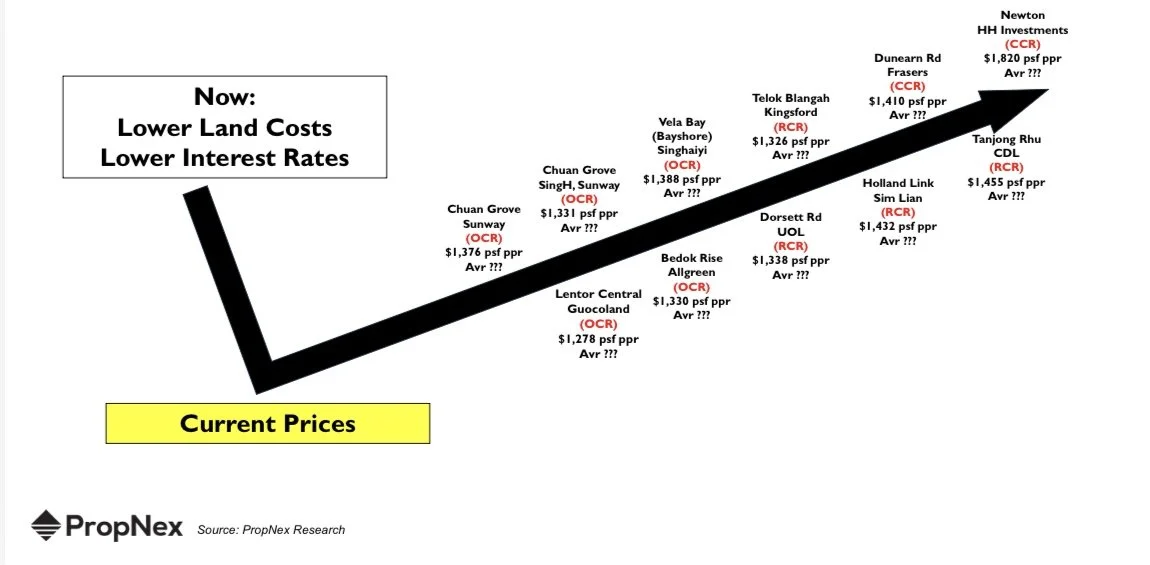
Current GLS prices for CCR, RCR and OCR plots
The OCR GLS plot of Bedok Rise near Tanah Merah MRT, sold for $1,330 psf ppr in January this year, already signals for us how much prices have moved as developers compete aggressively to replenish their depleting inventory of new launch units. Again, Singhaiyi’s upcoming OCR launch at Bayshore, the first launch in this upcoming Bayshore precinct and part of the Greater Southern Waterfront transformation, Vela Bay, with 70% of units offering rare, coveted sea views, would hence prove attractive to many, given that they bought the land for $1,388psf ppr, in 2025. Yes, some of that future transformation is already reflected in the land bid price, but this development is still the first of many other plots, meaning that buyers of Vela Bay have a first-mover advantage here, since the new Bayshore precinct will have around 10,000 new homes, 30% of which, are private.
So, if developers have already locked in higher land bid costs, together with higher labour and construction costs, are they going to sell new developments now at a lower, or a higher price? In effect, the new GLS land bid prices are like a crystal ball; they give us valuable insights as to future new development costs, as developers typically launch a new development 9 months to a year after they have bought the plot from the government. In this sense, the property market is retarded; the impact on future prices can be gauged from the prices of recent GLS plots now. It’s indeed a good time to do a review of your real estate portfolio (which I recommend you should do every 4-5 years with a real estate advisor) and consider carefully if a strategic move is now needed.